
Solve One-Step Equations Step by Step
Screenshot any one-step equation from your worksheet and see exactly which inverse operation solves it — in seconds.
Try for free- Works on any screenshot — textbook, PDF, or worksheet
- Full step-by-step solutions, not just the final answer
- Free to start — no account needed
- 1The variable has added to it, so subtract from both sides: .
- 2Simplify: .
- 3Check: ✓.
A one-step equation is solved by applying the single inverse operation to both sides: add what was subtracted, subtract what was added, multiply by what divided, divide by what multiplied.
Work out which operation is currently attached to the variable, undo exactly that on both sides so the equation stays balanced, then substitute your answer back into the original to confirm both sides agree.
If undoing takes two moves, or the variable appears more than once, it is not a one-step equation — those are two-step and linear equations, which follow a different order of operations.
What is a one-step equation?
A one-step equation is an equation you can solve by undoing exactly one operation. In , the only thing happening to is "add 9" — so one opposite move, subtracting 9 from both sides, reveals the answer.
The big idea is balance: an equation is a scale, and whatever you do to one side you must do to the other. Every equation type you will ever meet — two-step, linear, quadratic — is built on this single move done repeatedly.
There are only four cases, one per operation: something added to , subtracted from it, multiplying it, or dividing it. Each is undone by its inverse (opposite) operation.
Where you'll actually use this
- Sharing costs: "the three of us split the bill evenly and each paid $14 — what was the total?" is .
- Shopping: "after a $5 coupon I paid $23" is .
- Cooking: scaling a recipe that serves 4 up to 12 servings means solving .
- Saving: "I need $60 and already have $42" is .
The formulas you need
Keep these on hand — every method below builds on them.
Subtract the added number from both sides.
Add the subtracted number back to both sides.
Divide both sides by the coefficient in front of x.
Multiply both sides by the divisor.
How to solve one-step equations
Pick the method that fits the problem in front of you.
- 1Identify what is attached to : "" means addition is happening.
- 2Apply the opposite operation to both sides: subtract from each side.
- 3Simplify both sides — the left side collapses to just .
- 4Check by substituting the answer back into the original equation.
One-Step Equations, solved step by step
From easy to hard — pick a problem to see its full solution.
- 1The variable has added to it, so subtract from both sides: .
- 2Simplify: .
- 3Check: ✓.
- 1The variable has subtracted, so add to both sides: .
- 2Simplify: .
- 1 means times , so divide both sides by : .
- 2Simplify: .
- 1The variable is divided by , so multiply both sides by : .
- 2Simplify: .
- 1The variable is multiplied by , so divide both sides by — the whole coefficient, sign included.
- 2.
- 3Check: ✓.
Try it on your own one-step equations homework
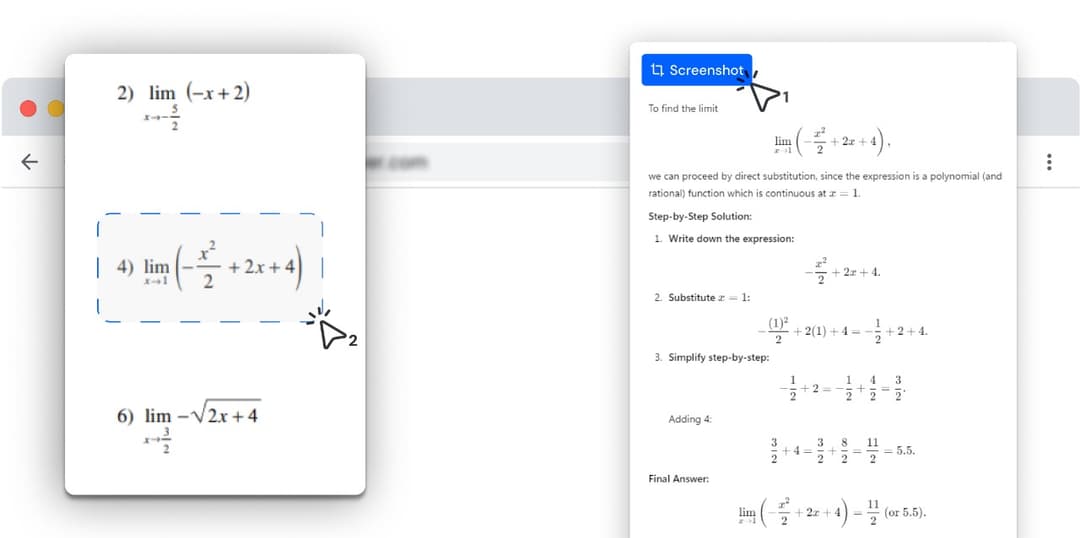
Photo Math Solver reads a one-step equation straight from a screenshot — a worksheet, a textbook page, an online quiz — and shows the single inverse operation that solves it, applied to both sides, with the check at the end. No retyping, and no wondering whether to add or subtract.
Now you try
Work each one on paper first, then check your answer.
Stuck on your one-step equations homework? Screenshot it
If a one-step equation on your worksheet has awkward numbers or fractions, screenshot it with Photo Math Solver instead of retyping it — it reads the equation straight off the page and shows the same isolate-the-variable steps you would do by hand.
Where points get lost
Each of these shows up on real graded work — and each has a simple fix.
| The mistake | Why it happens | The fix |
|---|---|---|
| Applying the inverse operation to only one side. | The focus is on "getting alone," so the other side of the scale gets forgotten. | Write the operation under both sides before simplifying anything — the equation is a balance, and both pans must change together. |
| Using the same operation instead of the inverse — adding when you should subtract. | Seeing "" primes your brain for addition, so you add 7 again instead of undoing it. | Say the undo out loud: "seven is added, so I subtract seven." Opposite pairs: and . |
| Treating as " plus 5" and subtracting. | A number sitting next to a letter does not show its multiplication sign, so the operation is easy to misread. | always means — undo it by dividing. Subtraction only applies when you see an explicit or . |
| Dropping the sign when the coefficient is negative. | Dividing by instead of feels close enough, but gives instead of . | Divide by the entire coefficient including its sign, then check by substituting: ✓. |
Photo Math Solver shows every intermediate step, so slips like these are easy to catch before they cost you marks.
Frequently asked questions
Related topics
Two operations, undone in reverse order — including negative coefficients and fraction forms.
Percentage Word ProblemsDiscounts, markups, percent change, and reverse problems — translating the sentence into the right formula.
Linear EquationsVariables on both sides, parentheses, and fractions — plus the no-solution and infinite-solution special cases.
Systems of EquationsSubstitution, elimination and graphing for two unknowns, including no-solution and infinite cases.
Quadratic EquationsFactoring, the quadratic formula, and completing the square — from x² − 5x + 6 = 0 to complex roots.
Area and PerimeterEvery plane-shape formula, plus composite figures and working backwards from a known area.