
Solve Integrals Step by Step
Screenshot any integral — bounds, substitutions, and all — and get the antiderivative with every step in seconds.
Try for free- Works on any screenshot — textbook, PDF, or worksheet
- Full step-by-step solutions, not just the final answer
- Free to start — no account needed
- 1Apply the power rule: raise the power by 1 and divide by the new power: .
- 2Simplify: .
- 3Add the constant of integration: .
An integral is found by reversing differentiation — recognising which function would differentiate to give the integrand, then adjusting for constants.
Try the reverse power rule first, use -substitution when the integrand contains a function and its own derivative, and integration by parts when it is a product of two unrelated functions.
An indefinite integral is a whole family of functions, so omitting the makes the answer incomplete — and for a definite integral the constant cancels, which is why it never appears there.
What is an integral?
An integral accumulates a quantity: the area under a curve, the total distance from a velocity graph, the total cost from a marginal-cost function. Where a derivative asks "how fast is this changing right now?", an integral asks "how much has piled up in total?"
The two operations are inverses — that is the Fundamental Theorem of Calculus. An indefinite integral recovers the family of functions whose derivative is (hence the ), while a definite integral plugs the bounds into that antiderivative to produce one number.
Areas below the x-axis count as negative, which is why a definite integral can be zero even when the curve is nowhere flat — the accumulated area above and below cancel out.
Where you'll actually use this
- Physics: integrating velocity gives distance traveled; integrating force over distance gives work done.
- Engineering: areas, volumes, and centers of mass of irregular shapes all come from integrals.
- Economics: total revenue accumulates from marginal revenue; consumer surplus is an area under a demand curve.
- Probability: the chance a value falls in a range is the integral of its probability density.
- Antiderivative
- A function whose derivative is the integrand: .
- Bounds (limits of integration)
- The values and in marking where accumulation starts and stops.
- Integrand
- The function being integrated — the expression between the sign and .
- Net area
- Area above the x-axis minus area below it; what a definite integral actually computes.
The formulas you need
Keep these on hand — every method below builds on them.
Raise the power by one, divide by the new power — the reverse of differentiation.
F is any antiderivative of f. Evaluate at the top bound minus the bottom bound.
The reverse chain rule: substitute u = g(x) when its derivative appears alongside.
The reverse product rule — for integrands like x·eˣ or x·cos x.
How to solve integrals
Pick the method that fits the problem in front of you.
- 1Split the integral across sums and pull constant factors out front.
- 2Integrate each term with the power rule: raise the exponent by 1, divide by the new exponent.
- 3Rewrite roots and reciprocals as powers first: , .
- 4Add a single for an indefinite integral.
- 5For a definite integral, skip the and evaluate instead.
Integrals, solved step by step
From easy to hard — pick a problem to see its full solution.
- 1Apply the power rule: raise the power by 1 and divide by the new power: .
- 2Simplify: .
- 3Add the constant of integration: .
- 1Integrate term by term with the power rule: , , and .
- 2Combine and add one constant: .
- 1Find the antiderivative: (no needed for a definite integral).
- 2Apply the Fundamental Theorem: .
- 3Result: — the area under from to .
- 1The derivative of is , which appears in the integrand — use substitution.
- 2Let , so .
- 3Rewrite: .
- 4Integrate: .
- 5Substitute back: .
- 1A polynomial times — substitution fails, so integrate by parts.
- 2Choose (simplifies when differentiated) and .
- 3Compute and .
- 4Apply the formula: .
- 5Finish: .
Try it on your own integrals homework
Photo Math Solver reads an integral straight from a screenshot — bounds included — and returns the full solution: the technique it chose, every intermediate step, and the final antiderivative or numeric value. No retyping ∫-signs and nested expressions into a calculator, and no guessing whether the problem needs substitution.
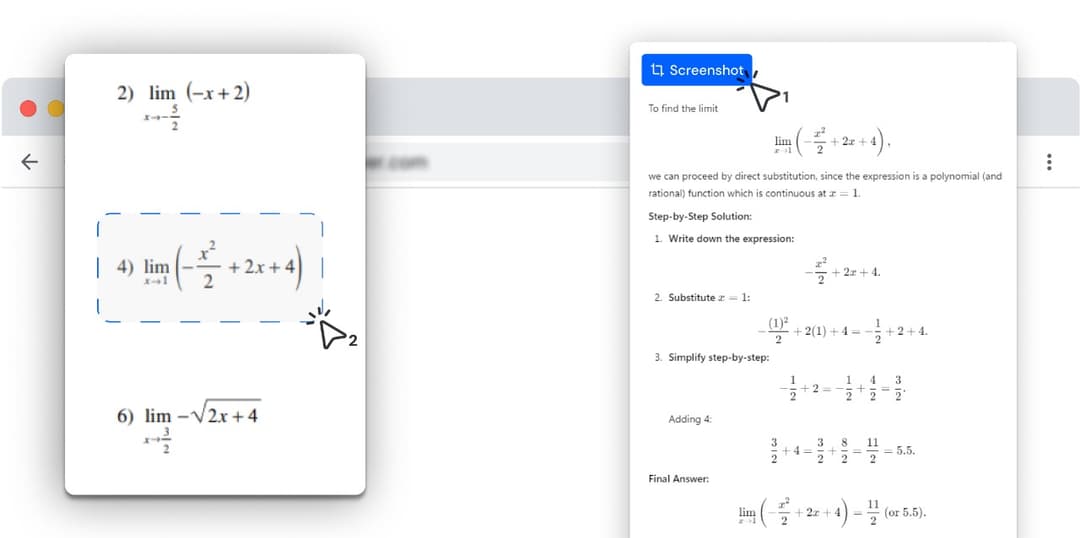
Now you try
Work each one on paper first, then check your answer.
Stuck on your integrals homework? Screenshot it
If an integral in your assignment involves a substitution or integration-by-parts setup that is tedious to retype, screenshot it with Photo Math Solver instead — it reads the expression straight from the page, bounds included, so you do not risk a transcription error before you even start solving.
Where points get lost
Each of these shows up on real graded work — and each has a simple fix.
| The mistake | Why it happens | The fix |
|---|---|---|
| Forgetting the on indefinite integrals. | The constant feels like bookkeeping, and definite-integral practice (where it cancels) trains you to drop it. | Write the moment you integrate, not at the end. On graded work it is often a dedicated point. |
| Applying the power rule to a composite like without substitution. | It looks like , so the reflex is to write directly — but that ignores the chain rule in reverse. | Differentiate your answer to check. The correct route sets and needs a matching in the integrand. |
| Losing constant factors during substitution. | When but the integrand only has , the required often silently disappears. | Solve for the exact quantity you have: , and carry the fraction through the whole computation. |
| Evaluating a definite integral as instead of . | The bottom bound is written first in , so it feels natural to plug it in first. | Top bound first, always: . A sign flip here inverts the entire answer. |
Photo Math Solver shows every intermediate step, so slips like these are easy to catch before they cost you marks.
Frequently asked questions
Related topics
Direct substitution, factoring and conjugates for 0/0, plus one-sided limits and limits at infinity.
DerivativesPower, product, quotient, and chain rule — from simple polynomials to nested compositions.
Quadratic EquationsFactoring, the quadratic formula, and completing the square — from x² − 5x + 6 = 0 to complex roots.
Area and PerimeterEvery plane-shape formula, plus composite figures and working backwards from a known area.
Surface Area and VolumePrisms, cylinders, cones, pyramids and spheres — including reverse problems and slant-height traps.
Trig IdentitiesThe full identity toolkit plus a reliable strategy for verifying an identity one side at a time.