
Solve Limits Step by Step
Screenshot the limit and get the technique named — why substitution failed, and what to do about it.
Try for free- Works on any screenshot — textbook, PDF, or worksheet
- Full step-by-step solutions, not just the final answer
- Free to start — no account needed
- 1Polynomials are continuous everywhere, so substitute directly.
- 2.
A limit is evaluated by direct substitution whenever that produces a number; getting means the expression needs algebraic work before the limit can be read off.
Factor and cancel the common term, multiply by the conjugate when a radical is involved, or compare the leading degrees of numerator and denominator for a limit at infinity.
is not an answer — it is an indeterminate form telling you substitution failed, and recording it as zero or as undefined is the most common way to lose the question outright.
What is a limit?
A limit describes what a function approaches as its input approaches some value — not necessarily what it equals there. says that as gets arbitrarily close to , gets arbitrarily close to , whether or not is even defined.
That gap between "approaches" and "equals" is the entire point. is undefined at because the denominator is zero, yet the function settles on from both sides. The limit sees the trend; the value at the point is a separate question.
Limits are the foundation the rest of calculus sits on. A derivative is a limit of a difference quotient, a definite integral is a limit of a sum, and continuity is defined as the limit matching the function value. Everything downstream is built here.
Where you'll actually use this
- Instantaneous speed: average speed over a shrinking time interval, in the limit, is the speedometer reading.
- Compound interest compounded ever more frequently approaches — a limit.
- Terminal velocity and other long-run steady states are limits as time goes to infinity.
- Numerical methods and floating-point analysis, where convergence is a limit statement.
- Marginal cost in economics: the limit of the cost of one more unit as the increment shrinks.
- Limit
- The value a function approaches as its input approaches a given point.
- Indeterminate form
- An expression like or that carries no information until the algebra is done.
- One-sided limit
- The value approached from only the left () or only the right ().
- Continuity
- A function is continuous at when exists, the limit exists, and they are equal.
- Removable discontinuity
- A single-point hole where the limit exists but the function is undefined — what cancelling a common factor reveals.
The formulas you need
Keep these on hand — every method below builds on them.
As x approaches a, f(x) approaches L.
A limit exists only if both one-sided limits agree.
Not an answer — a signal that algebra is needed before substituting.
For n > 0 — the workhorse behind every rational-function limit at infinity.
The definition: the limit exists and matches the actual value.
x in radians. Worth memorising — it underlies the derivative of sine.
How to solve limits
Pick the method that fits the problem in front of you.
- 1Substitute the value into the function: gives .
- 2A defined real number is the answer — stop there.
- 3If you get , the limit still probably exists; move to an algebraic technique.
- 4If you get a non-zero number over zero, such as , the limit is infinite or does not exist.
Limits, solved step by step
From easy to hard — pick a problem to see its full solution.
- 1Polynomials are continuous everywhere, so substitute directly.
- 2.
- 1Substitution gives — indeterminate, so factor.
- 2The numerator is a difference of squares: .
- 3Cancel and substitute: .
- 1Substitution gives .
- 2Factor the numerator: .
- 3Cancel , leaving . Substitute: .
- 1Substitution gives , and there is a radical — use the conjugate .
- 2The numerator becomes , so the fraction is .
- 3Cancel : . Substitute: .
- 1Both are degree 2, so the limit is the ratio of the leading coefficients.
- 2Formally: divide every term by to get .
- 3Each term goes to , leaving .
- 1From the right, , so the fraction is and the limit is .
- 2From the left, , so the fraction is and the limit is .
- 3The one-sided limits disagree, so the two-sided limit does not exist.
- 1Expand the numerator: .
- 2Factor out and cancel: .
- 3Substitute : the limit is — this is the derivative of from first principles.
Try it on your own limits homework
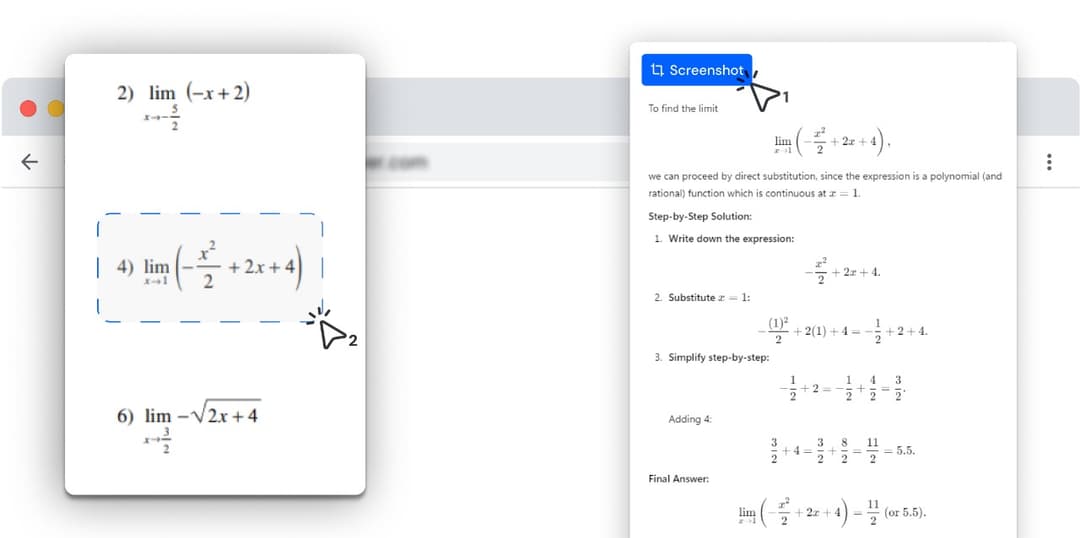
Photo Math Solver reads a limit straight from a screenshot — a $\frac{0}{0}$ form that needs factoring, a radical needing a conjugate, a rational function heading to infinity — and shows the full working: what direct substitution gave, why that was not the answer, and which algebraic move resolved it.
Now you try
Work each one on paper first, then check your answer.
Stuck on your limits homework? Screenshot it
Limit notation stacks a subscript under the operator and often wraps a nested fraction or radical, which makes it slow to retype and easy to garble. Screenshot the whole expression with Photo Math Solver and the solution states what direct substitution gave, why it was inconclusive, and which technique resolved it.
Where points get lost
Each of these shows up on real graded work — and each has a simple fix.
| The mistake | Why it happens | The fix |
|---|---|---|
| Reporting as the answer, or as "does not exist". | Substitution is the first technique taught, and whatever it produces looks like the result. | is indeterminate — it means the method was inconclusive, not that the limit fails. Factor, use a conjugate, or apply L'Hôpital's rule, then substitute again. |
| Assuming must equal . | It is true for every polynomial, which is where all the early examples come from. | That equality is the definition of continuity, not a general rule. A limit can exist where the function is undefined, and can differ from the value at a jump or a removable hole. |
| Refusing to cancel a factor because it is zero at the limit point. | Cancelling when looks like dividing by zero, which is correctly drilled as forbidden. | The limit considers arbitrarily close to but never equal to it, so is never actually zero. Cancelling is valid throughout the region the limit cares about. |
| Concluding a two-sided limit exists after checking only one side. | One side gives a clean number that looks like a finished answer. | Check both. For piecewise functions, absolute values, and vertical asymptotes, the sides routinely disagree — and if they do, the two-sided limit does not exist. |
| Treating as a number and writing . | It appears in the same position an ordinary value would, so ordinary cancellation seems to apply. | is indeterminate, exactly like . Compare degrees, or divide through by the highest power, to get the real answer. |
Photo Math Solver shows every intermediate step, so slips like these are easy to catch before they cost you marks.
Frequently asked questions
Related topics
Power, product, quotient, and chain rule — from simple polynomials to nested compositions.
IntegralsAntiderivatives, u-substitution, and integration by parts — definite and indefinite, bounds included.
Quadratic EquationsFactoring, the quadratic formula, and completing the square — from x² − 5x + 6 = 0 to complex roots.
Linear EquationsVariables on both sides, parentheses, and fractions — plus the no-solution and infinite-solution special cases.
Trig IdentitiesThe full identity toolkit plus a reliable strategy for verifying an identity one side at a time.
Right Triangle TrigonometrySOHCAHTOA for missing sides and inverse functions for missing angles, including elevation and depression.