
Solve Percentage Word Problems Step by Step
Screenshot the whole word problem — sentence and all — and watch it get translated into an equation and solved in seconds.
Try for free- Works on any screenshot — textbook, PDF, or worksheet
- Full step-by-step solutions, not just the final answer
- Free to start — no account needed
- 1Translate: the tip is of , so .
- 2The tip is $12.
- 3The question also asks the total: dollars.
A percentage word problem is solved by working out which of the three quantities is missing — the part, the whole, or the percent — and then applying .
Translate the sentence into that relationship, convert the percentage to a decimal by dividing by , and solve for whichever quantity the question left out.
Repeated percentage change does not follow this rule: compound interest and successive discounts multiply growth factors rather than adding percentages, so applying this formula twice gives the wrong answer.
What are percentage word problems?
Percentage word problems describe a part-whole relationship in a sentence: a discount off a price, a markup on a cost, a tip on a bill, a score improvement. The percent connects a part to its whole: .
The arithmetic is rarely the hard part — the translation is. Every problem gives you two of the three quantities (part, percent, whole) and asks for the third, but hides which is which behind words like "off," "of," "markup," and "after."
The trickiest variant runs backwards: "the price after a 40% markup is $84 — what was the original?" Here $84 is not the whole but 140% of it, and recognizing that is the entire battle.
Where you'll actually use this
- Shopping: stacking a 20% discount with a coupon, or checking whether "40% off" beats "buy one get one half off."
- Money: tips, sales tax, interest on savings, and loan rates are all percent calculations.
- School and work: grade improvements, population growth, and profit margins are percent-change problems.
- News literacy: telling a 5-percentage-point change apart from a 5% relative change.
The formulas you need
Keep these on hand — every method below builds on them.
Two of the three are always given; solve for the third.
A 40% markup multiplies by 1.40 in one move.
A 20% discount multiplies by 0.80.
Always divide by the OLD value, not the new one.
How to solve percentage word problems
Pick the method that fits the problem in front of you.
- 1Convert the percent to a decimal: .
- 2Multiply by the whole: .
- 3Read the question again — some problems want the part itself, others want the total including it (bill + tip).
Percentage Word Problems, solved step by step
From easy to hard — pick a problem to see its full solution.
- 1Translate: the tip is of , so .
- 2The tip is $12.
- 3The question also asks the total: dollars.
- 1Find the discount amount: .
- 2"Off" means subtract: .
- 3The sale price is $40. (Shortcut: .)
- 1Find the markup amount: .
- 2"Markup" means add: .
- 3The new price is $84. (Shortcut: .)
- 1Find the change: points.
- 2Divide by the ORIGINAL score: .
- 3Convert to a percent: increase.
- 1Translate carefully: $84 is the price AFTER the markup, so it equals of the original.
- 2Write the equation: .
- 3Divide: .
- 4The original price was $60. Check: ✓.
Try it on your own percentage word problems homework
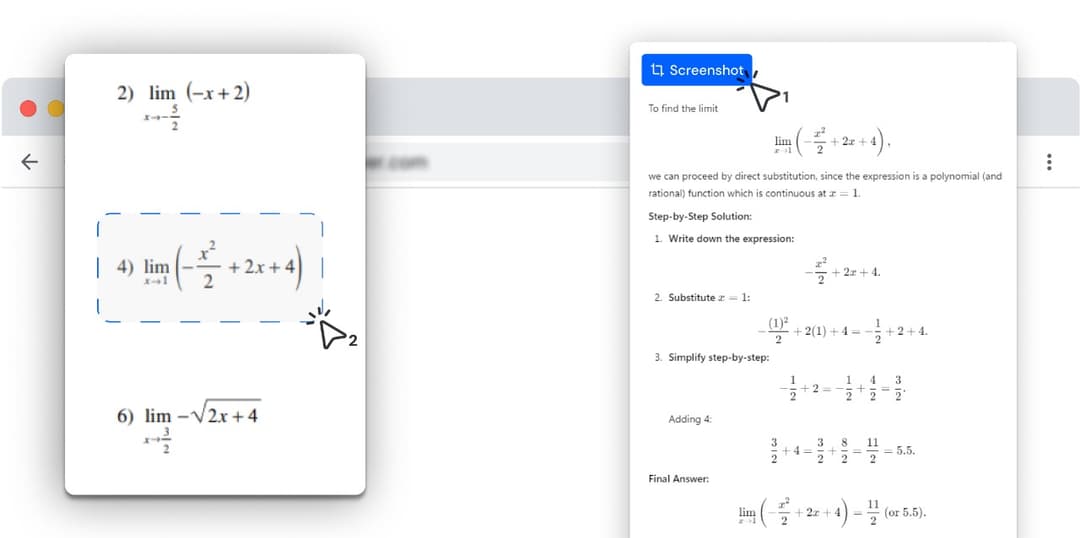
Photo Math Solver reads the entire word problem from a screenshot — the sentence, not just the numbers — and shows the translation step first: which value is the whole, which is the percent, what the question actually asks. Then it solves, step by step. No fishing numbers out of a paragraph, and no guessing whether to add or subtract the change.
Now you try
Work each one on paper first, then check your answer.
Stuck on your percentage word problems homework? Screenshot it
Percentage word problems hide the actual numbers inside a long sentence, making them tedious to retype. Screenshot the problem with Photo Math Solver and it will pull out the relevant numbers, show the translation into an equation, and walk through the same part/whole/percent steps.
Where points get lost
Each of these shows up on real graded work — and each has a simple fix.
| The mistake | Why it happens | The fix |
|---|---|---|
| Stopping at the percent amount instead of answering the question. | Computing "20% of $50 = $10" feels like the finish line, but the question asked for the sale price. | Re-read the final sentence of the problem after computing. If it asks for a price, your answer should be a price — apply the add or subtract step. |
| Adding when the problem says decrease, or subtracting on a markup. | The direction hides in a single word — "off," "discount," "markup," "grew" — and it is easy to skim past. | Circle the direction word before computing. Off/discount/decrease → subtract; markup/tax/tip/increase → add. |
| Solving reverse problems by taking the percent of the FINAL price. | Given "$84 after a 40% markup," subtracting 40% of 84 (giving $50.40) feels symmetric — but the 40% was applied to the original, not the final. | Write the forward equation first: , then divide. The original is , not . |
| Dividing by the new value when computing percent change. | Both numbers are on the page, and the larger or more recent one attracts the division. | Percent change always compares to where you started: . From 60 to 75 is , not . |
Photo Math Solver shows every intermediate step, so slips like these are easy to catch before they cost you marks.
Frequently asked questions
Related topics
The starting point of algebra: undo one operation with its inverse to find the variable.
Two-Step EquationsTwo operations, undone in reverse order — including negative coefficients and fraction forms.
Linear EquationsVariables on both sides, parentheses, and fractions — plus the no-solution and infinite-solution special cases.
Systems of EquationsSubstitution, elimination and graphing for two unknowns, including no-solution and infinite cases.
Quadratic EquationsFactoring, the quadratic formula, and completing the square — from x² − 5x + 6 = 0 to complex roots.
Area and PerimeterEvery plane-shape formula, plus composite figures and working backwards from a known area.