
Solve Two-Step Equations Step by Step
Screenshot any two-step equation and see both undo-moves — in the right order, applied to both sides — in seconds.
Try for free- Works on any screenshot — textbook, PDF, or worksheet
- Full step-by-step solutions, not just the final answer
- Free to start — no account needed
- 1Subtract from both sides: .
- 2Divide both sides by : .
- 3Check: ✓.
A two-step equation is solved by undoing addition or subtraction first and multiplication or division second — the reverse of the order you would use to evaluate it.
Strip the constant off the variable side, divide through by the coefficient, and check by substituting the result back into the original equation.
This works while the variable appears exactly once; brackets to expand or a variable on both sides make it a linear equation, where terms have to be collected before any undoing starts.
What is a two-step equation?
A two-step equation puts two operations on the variable at once — usually a multiplication or division paired with an addition or subtraction, like . Solving it means undoing both, one at a time.
The order matters, and it runs in reverse: the equation was built by first multiplying by 4, then subtracting 5 — so you unwrap it backwards, adding 5 first, dividing by 4 second. Think of unwrapping a present: last layer on, first layer off.
Master this pattern and you have the core move of all of algebra: every longer equation — with parentheses, fractions, or variables on both sides — eventually simplifies down to exactly this two-step finish.
Where you'll actually use this
- Phone plans: "$25 base fee plus $10 per gigabyte came to $65" is .
- Taxi and delivery pricing: a fixed pickup fee plus a per-mile rate is the classic .
- Saving up: "I have $40 and save $15 a week — when do I reach $130?" is .
- Temperature conversion: solving for is a two-step equation.
The formulas you need
Keep these on hand — every method below builds on them.
A coefficient on x plus a constant — the shape every two-step equation reduces to.
Move the constant first (subtract b), then divide by the coefficient a.
Reverse of the order of operations — undo the outermost layer (addition/subtraction) first.
Same order: clear the constant first, then multiply through by the divisor.
How to solve two-step equations
Pick the method that fits the problem in front of you.
- 1Undo the addition or subtraction first: subtract from both sides, giving .
- 2Undo the multiplication: divide both sides by , giving .
- 3Check: ✓.
Two-Step Equations, solved step by step
From easy to hard — pick a problem to see its full solution.
- 1Subtract from both sides: .
- 2Divide both sides by : .
- 3Check: ✓.
- 1Add to both sides: .
- 2Divide both sides by : .
- 1Subtract from both sides: .
- 2Multiply both sides by : .
- 1Subtract from both sides: .
- 2Divide both sides by , keeping the sign: .
- 3Check: ✓.
- 1Rewrite mentally as — the variable term is negative.
- 2Subtract from both sides: .
- 3Divide both sides by : .
- 4Check: ✓.
Try it on your own two-step equations homework
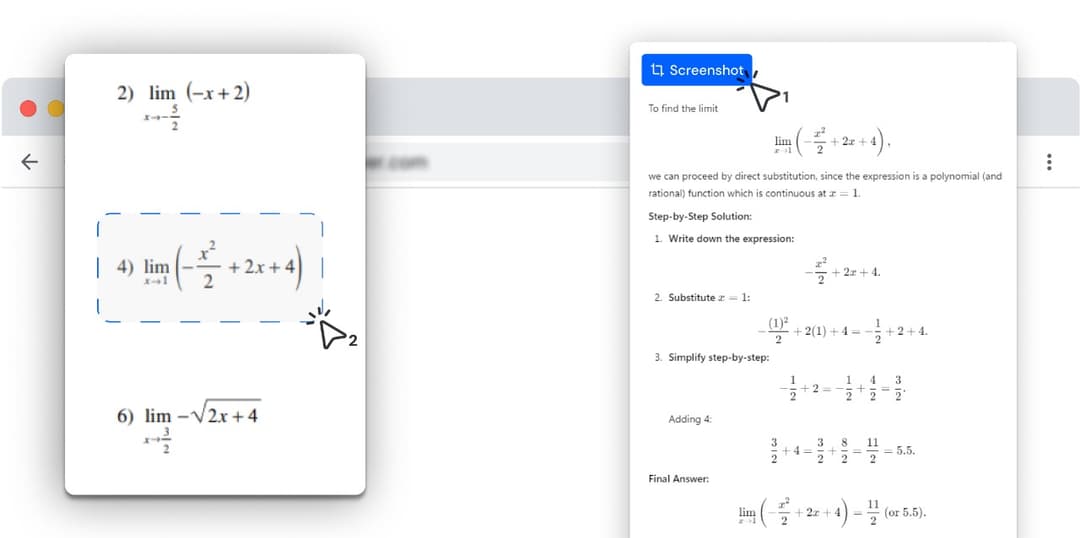
Photo Math Solver reads a two-step equation straight from a screenshot — worksheet, textbook, or online quiz — and shows both moves in the right order: constants first, coefficient second, each applied to both sides, with a check at the end. No retyping decimals or negatives, and no second-guessing which step comes first.
Now you try
Work each one on paper first, then check your answer.
Stuck on your two-step equations homework? Screenshot it
Two-step equations with decimals or negative coefficients are easy to mistype into a calculator. Screenshot the equation with Photo Math Solver wherever it appears — homework PDF, textbook page, online quiz — and get the isolated-variable steps without re-entering the numbers.
Where points get lost
Each of these shows up on real graded work — and each has a simple fix.
| The mistake | Why it happens | The fix |
|---|---|---|
| Dividing before moving the constant: turning into . | Dividing by the coefficient feels like the most direct route to , so it gets done first. | Undo in reverse order of operations: clear the added or subtracted constant first, divide last. (If you must divide first, you have to divide every term — usually messier.) |
| Applying a step to only one side. | After the first step succeeds, attention shifts to the variable side and the other side gets left behind. | Write each operation under both sides before simplifying — every line of working should keep the scale balanced. |
| Dropping the sign when dividing by a negative coefficient. | From , dividing by instead of feels close enough but flips the answer’s sign. | Divide by the coefficient exactly as written, sign included: . Then substitute back to confirm. |
| In , subtracting the instead of the . | The constant appearing first in reading order makes the variable term look like the thing to remove. | Rewrite the left side as first. Now it is a standard two-step: subtract , then divide by . |
Photo Math Solver shows every intermediate step, so slips like these are easy to catch before they cost you marks.
Frequently asked questions
Related topics
The starting point of algebra: undo one operation with its inverse to find the variable.
Percentage Word ProblemsDiscounts, markups, percent change, and reverse problems — translating the sentence into the right formula.
Linear EquationsVariables on both sides, parentheses, and fractions — plus the no-solution and infinite-solution special cases.
Systems of EquationsSubstitution, elimination and graphing for two unknowns, including no-solution and infinite cases.
Quadratic EquationsFactoring, the quadratic formula, and completing the square — from x² − 5x + 6 = 0 to complex roots.
Pythagorean TheoremFind the hypotenuse or a missing leg of a right triangle, including the converse and distance problems.